---
title: Pace New York Cooling Towers
---
[ ](https://www.pacelabs.com)
- [Analytical + Environmental](https://www.pacelabs.com/analytical-environmental/)
- [Life Sciences](https://www.pacelabs.com/life-sciences/)
- [Professional Services](https://www.pacelabs.com/professional-services/)
- [Blog](https://blog.pacelabs.com/keeping-pace-with-analytical-services)
# **New York Cooling Tower *Legionella* Law**
**Local Law 159 of 2025** significantly strengthens New York City’s cooling tower public health requirements in response to a major **Legionnaires’ disease outbreak in Central Harlem in 2025**. That outbreak occurred despite prior quarterly testing rules, prompting the City Council and DOHMH to conclude that **more frequent monitoring was necessary to detect *Legionella* earlier and prevent future clusters**. NYC doubles Legionnaires' inspectors, triples testing frequency ahead of summer
The law updates NYC’s cooling tower framework (originally created after the 2015 South Bronx outbreak) and is implemented through **amendments to Chapter 8 of Title 24 of the NYC Health Code**, adopted by DOHMH in April 2026 and effective **May 7–8, 2026**.
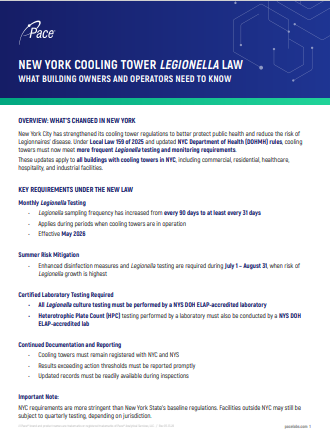
Download New York Cooling Tower *Legionella* Law info sheet:
#### **Key Change: Monthly *Legionella* Testing**
The most important change is the **increase in *Legionella* testing frequency**:
- **Before**: Cooling towers had to be tested **at least once every 90 days** while in operation.
- **Now** (under Local Law 159):
- - Cooling towers must be tested **at least once every 31 days (monthly)** during their operating season.
- DOHMH rules clarify that **no more than 31 days may pass** between samples.
This effectively increases *Legionella* testing from **4 tests per year to as many as 12 per year** for towers that operate year‑round.
### **Who Must Comply**
The law applies broadly to **all buildings in New York City that operate cooling towers**, including:
- Commercial office buildings
- Large residential buildings and co‑ops
- Hotels
- Hospitals and healthcare facilities
- Industrial buildings with evaporative cooling systems
These requirements are **specific to NYC** and are stricter than New York State regulations, which still generally require quarterly testing outside the five boroughs.
#### **Additional DOHMH Rule Clarifications and Monitoring Requirements**
Local Law 159 does not replace prior rules—it **adds to them**. Under the updated DOHMH regulations:
- **Seasonal startup testing** (within 14 days of bringing a tower online) is still required.
- **Weekly water quality monitoring** (e.g., disinfectant levels, pH, conductivity) remains mandatory.
- **Quarterly compliance inspections** by qualified professionals are still required.
- **Annual certification of compliance** must still be filed with DOHMH by **November 1** each year
The updated rules reinforce expectations for **documentation, record retention, and rapid corrective action** when Legionella results exceed action thresholds.
#### **Enhanced Warm Weather Controls**
The law and accompanying rules also emphasize **preventive measures during high-risk summer months**:
- DOHMH requires or expect **enhanced disinfection (e.g., hyper halogenation)** during periods of elevated *Legionella* risk, typically **July 1 through August 31**.
- These measures are designed to address conditions when warm temperatures accelerate bacterial growth in cooling towers.
- Monthly testing allows earlier identification of *Legionella* growth.
- Faster detection supports quicker corrective action and outbreak prevention.
- DOHMH has also expanded inspection capacity and reporting oversight following the 2025 outbreak.
#### **Enforcement and Public Health Rationale**
NYC health officials describe the law as a shift toward **shortening detection windows** and **faster intervention**:
Failure to comply can lead to **violations, doubled monetary penalties, and potential shutdown orders**, particularly if towers are linked to disease investigations.
### **Summary**
Local Law 159 of 2025 fundamentally shifts NYC’s approach to cooling tower safety by moving from **quarterly to monthly *Legionella* testing**, reinforced by stricter DOHMH monitoring and documentation rules. The intent is clear: **detect problems sooner, intervene faster, and reduce the risk of deadly Legionnaires’ disease outbreaks in dense urban environments**.
**How Pace® Supports Compliance with Local Law 159**
Pace® environmental testing and analytical services are designed to support full compliance with Local Law 159 of 2025 and the updated NYC Department of Health (DOHMH) cooling‑tower requirements. As a **New York State ELAP**‑**accredited laboratory**, Pace® provides ***Legionella* testing that meets the City’s requirements for certified laboratory analysis**, supporting the mandated monthly (31‑day) sampling schedule during cooling‑tower operation.
##### ANALYTICAL + ENVIRONMENTAL
ANALYTICAL + ENVIRONMENTAL
- [Analytical + Environmental](https://www.pacelabs.com/analytical-environmental/)
- [Emergency Services](https://www.pacelabs.com/analytical-environmental/emergency-disaster/)
- [Statement of Qualifications](https://info.pacelabs.com/hubfs/Statement%20of%20Qualifications/Pace%20SOQ.pdf)
##### LIFE SCIENCES
LIFE SCIENCES
- [Life Sciences Page](https://www.pacelabs.com/life-sciences.html)
- [CDMO/CRO Services](https://www.pacelabs.com/life-sciences/cdmo-cro-services/)
- [Central Laboratory Services](https://www.pacelabs.com/life-sciences/central-laboratory-services/)
- [Medical Device](https://www.pacelabs.com/life-sciences/medical-device/)
##### PROFESSOINAL SERVICES
PROFESSOINAL SERVICES
- [Professional Services](https://www.pacelabs.com/professional-services/)
- [Regulatory & Compliance](https://www.pacelabs.com/professional-services/regulatory-and-compliance/)
- [Scientific Staff](https://www.pacelabs.com/professional-services/scientific-staff/)
- [Instrument Services](https://www.pacelabs.com/professional-services/instruments/)
- [Facility Qualification](https://www.pacelabs.com/professional-services/facilities/)
##### OTHER
OTHER
- [Company](https://www.pacelabs.com/company/)
- [Careers](https://www.pacelabs.com/careers/)
- [Contact](https://www.pacelabs.com/contact-us/)
- [Privacy Policy](https://www.pacelabs.com/legal-notice.html)
Copyright © 2026 Pace®